Guy on Mountain Dropping Tennis Ball Mountain Clip Art
Ball lightning is one of the best-known natural phenomena that few have seen. Until contempo years, most scientists remained skeptical about ball lightning; it seemed more myth than reality. Nowadays, brawl lightning'south street cred amid scientists is stronger, only information technology'due south even so the case that about of the images you run into online purporting to be brawl lightning are just over-exposed images of ordinary lightning. In fact, no expert we asked could point us to an bodily image of ball lightning in nature. What is brawl lightning? Since the fourth dimension of the early on Greeks, there've been reports of pocket-sized balls of brilliant plasma-similar light moving over the ground and then vanishing. The explanation still eludes scientists for the nearly function, although diverse explanations have at present been offered. And now in that location is a potential new answer, based on previous research, to this baffling mystery.
The research has been published in a new peer-reviewed paper in the July 2019 issue of the journal Optik by Vladimir Torchigin from the Russian Academy of Sciences.
As the name suggests, ball lightning has ofttimes been thought of as a form of lightning. That might not actually exist the case, however; it might not be true lightning. A previously proposed hypothesis by Torchigin had suggested that these weird orbs are simply low-cal trapped inside a sphere of sparse air. The new paper at present expands on that thought and proposes physical parameters for how these things might exist.
Torchigin had previously suggested that the light balls consist of photons – elementary particles that are basic units of light – ricocheting within an air-bubble of their own making. His hypothesis is based on the premise that as any particle absorbs and emits electromagnetic radiations, in that location is a recoil referred to equally the Abraham-Lorentz force. Light spilling from a lightning strike causes air particles to jiggle as they absorb and transmit electromagnetic radiations.
These forces are ordinarily very small, merely could exist amplified nether the right conditions: the generation of a thin layer of air that refracts the light back in on itself. From the abstract of the paper:
Nosotros testify that the mysterious and intriguing behavior of ball lightning, observed by many eyewitnesses, is explained on the assumption that brawl lightning consists merely of light and compressed air. In dissimilarity to a lather bubble, the spherical crush of a ball lightning consists of highly compressed air, in which ordinary white light rotates in all possible directions. Light compresses the air due to optical electrostrictive pressure. In plough, the vanquish of compressed air is a two-dimensional lightguide that prevents the propagation of light in gratuitous infinite. Thus, ball lightning is a cocky-confined light in a nonlinear optical medium in the grade of the conventional air atmosphere.
The sparse layer of air would resemble the flick of a soap bubble. This "bubble" could focus light like a lens. When the calorie-free is intensified enough, air particles would get shoved into an outer purlieus – the film of the bubble – where photons could exist concentrated for seconds at a time.
Some of these "embryo" bubbles would fade away again speedily due to a lack of lite or a bubble surface that isn't completely closed. The ones that did last longer would exist what we call brawl lightning.
So how did Torchigin come to these conclusions?
The hypothesis is a combination of previous assumptions with physical models that pins down the light density and air force per unit area required to produce such light-focusing bubbles. Is information technology the complete answer? Not all the same. There are some details it doesn't explicate however, such as a case in Cathay a few years ago where ball lightning was reported after a lightning strike. The event was captured on a spectrograph, then scientists were able to obtain a breakup of its electromagnetic spectrum. It may also not explain the sulfurous smells sometimes reported. Merely information technology could pb to experiments that would either confirm or deflate this latest proposal for how ball lightning works.
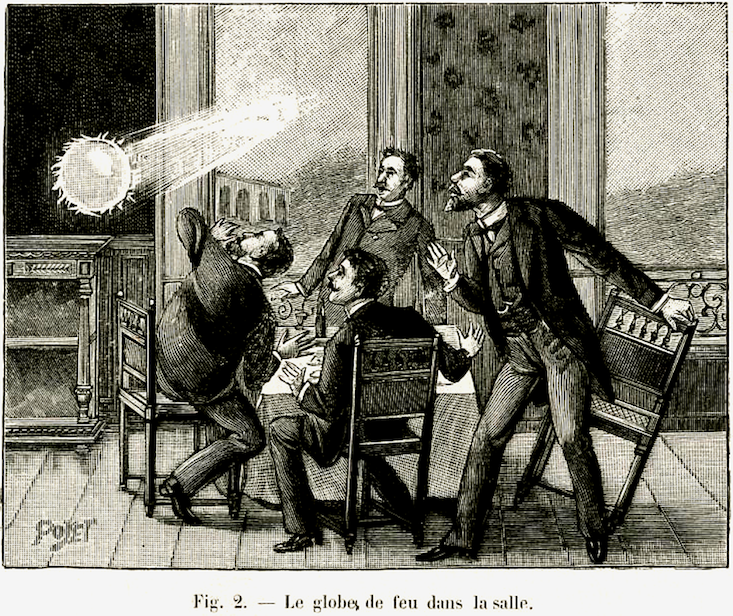
Ball lightning has been reported for centuries. The orbs are typically near the size of a grapefruit, moving slowly over the ground. They have been seen during electrical storms, hence the early theories that they were just a different form of lightning. They usually disappear after x seconds, quietly, simply sometimes a bang audio can be heard. They take even been observed to pass through airtight windows!
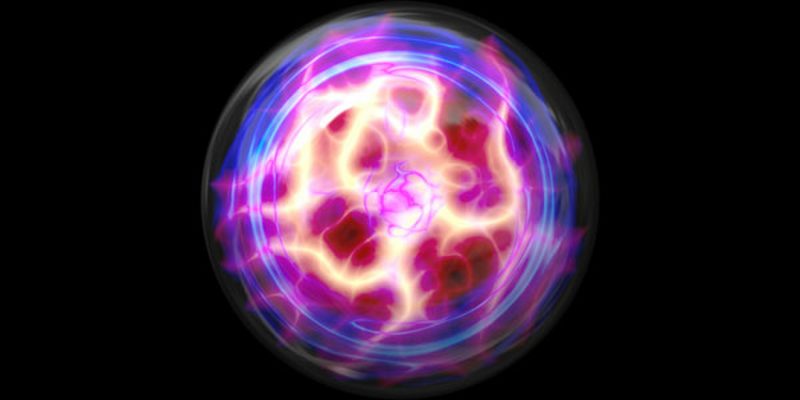
In another theory, University of Canterbury engineer John Abrahamson suggested that brawl lightning could be the result of vaporized footing material existence pushed up past a shockwave of air. The vaporized silica condenses into nanoparticles – microscopic particles with at least one dimension less than 100 nanometer – and is bound together by electrical charges. It glows hot due a chemic reaction between the silicon and oxygen in the air.
Iii bones features of brawl lightning were described in the 1970s by Stanley Singer: the duration, the floating move and the sudden disappearance. All need to exist accounted for by any proposed theories.
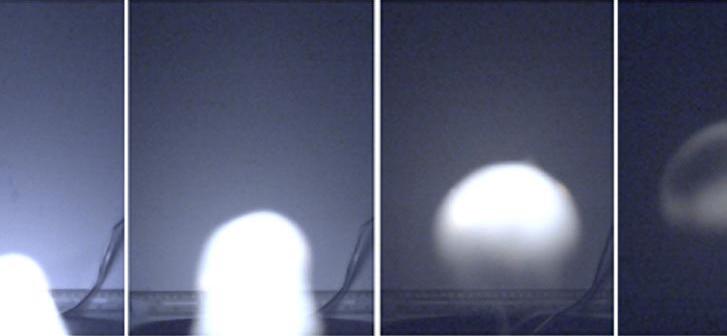
One of the earliest documented reports of ball lightning is from a stormy Sunday in 1638. A parish church in Devonshire, England, went up in flames every bit a result and some of the people inside were killed. At that place have been thousands of sightings since then. Ball lightning, or something similar at least, has even been created in the laboratory. In a study from 2007, published in the journal Concrete Review Letters, researchers at the Federal University of Pernambuco in Brazil used electricity to vaporize tiny wafers of silicon. This created blue or orange-white spheres the size of ping-pong assurance that hovered around for as long as eight seconds.
Bottom line: Ball lightning has long been a mysterious phenomenon, the explanation of which has eluded scientists for hundreds of years. But thanks to the connected research of scientists similar Torchigin, it seems like the reply to this puzzle may finally exist close at hand.
Source: Physics of a ball lightning in a class of a bubble of lite
Via Science Alert
Source: https://earthsky.org/earth/ball-lightning-lightning-atmosphere-earth-optik/
0 Response to "Guy on Mountain Dropping Tennis Ball Mountain Clip Art"
Post a Comment