Is Japan Whaling Again in Antarctica
Even before the coronavirus pandemic began to dominate the news, and as Australia's bush-league fires took nigh of the media oxygen, this past summer was an unusually quiet period in the long-running "whaling wars" in the Southern Ocean.
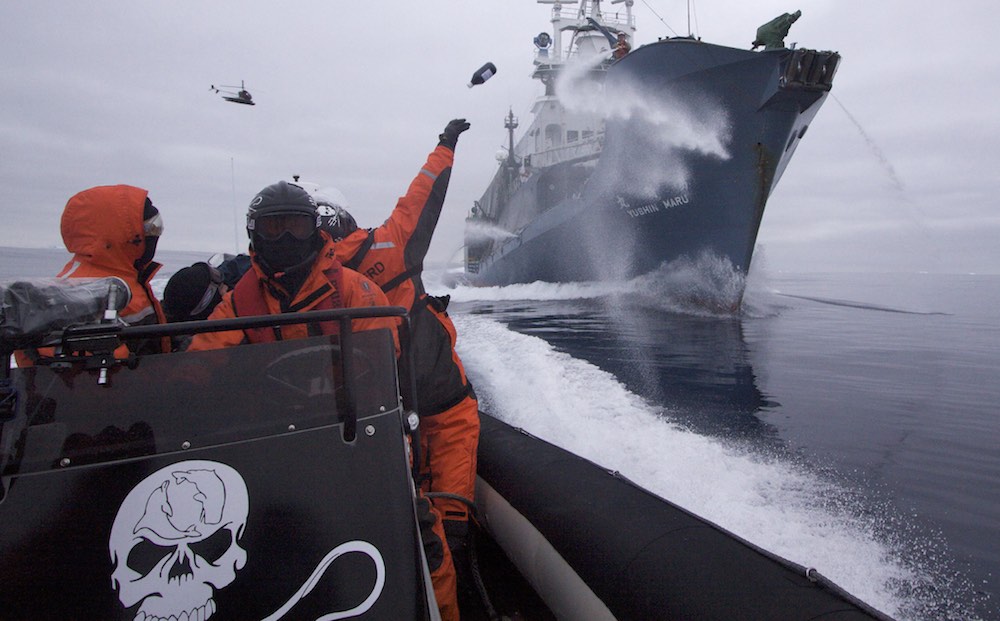
For the outset time in years, a southern summer passed without a Japanese whaling mission in the region well-nigh Antarctica – activities that had routinely fatigued criticism from the Australian authorities and conservationists, in some years leading to heated clashes at sea with vessels from the activist group Sea Shepherd.
Japan's retreat from the region's whale sanctuary is role of a broader reframing of the country'south whaling policies. This was the first southern summer since Japan withdrew from the International Whaling Commission (IWC) and switched its explicit focus to commercial whaling, but just within its ain sectional economic zone. Consequently, Japan scrapped the annual Southern Ocean program that information technology had always claimed was for scientific research purposes merely was in one forum ruled in breach of international law.
Japan scrapped the annual Southern ocean program that it had always claimed was for scientific enquiry purposes only was in one forum ruled in breach of international police force.
Although Japan faced some initial criticism for quitting the international body that manages whale conservation issues, its simultaneous scrapping of the controversial Southern Sea missions lowered the temperature of debate and arguably helped the country escape harsh scrutiny over its embrace of commercial whaling. This time last twelvemonth, Nihon'southward whaling vessels returned domicile from their final "research" mission in the Southern Sea with a haul of 333 minke whales, which were to be made available for consumption.
Marine conservationists emphasise the importance of a whaling-complimentary summer. "Historic" is the description used by Darren Kindleysides of the Australian Marine Conservation Society. He noted it was the outset fourth dimension in 100 years that whales in the region had been gratuitous from the threat of hunting, with a few exceptions such as a pause during the 2d Earth War and a filibuster after Australia won its example confronting Japan at the International Court of Justice in 2014.
But as conservationists like Kindleysides point out, this is not the end of the story, merely merely ane step frontwards in the fight against commercial whaling effectually the globe. "We can't let ourselves to think that that's the finish of the matter," he said.
Afterward all, Nippon prepare its whalers a catch quota of 227 from within its littoral regions last year, comprising 52 minke, 150 Bryde'southward, and 25 sei whales, with the total national limit ascent to 383 this year.
Japan has said it volition maintain observer status at the IWC, an important signal that it has not completely close the door to international talks on the issue. The Japanese government had long objected to the IWC's moratorium on commercial whaling that took effect 35 years ago, arguing that information technology was only ever meant to be temporary, and had also been frustrated at beingness on the losing terminate of recent votes.
With the world'due south focus currently on containing the coronavirus, still, the IWC is some other in a long line of international organisations grappling with how to keep with its work. The IWC was due to concord a meeting of its scientific committee in the Britain in May, merely as a result of broad travel restrictions it will try to do this through a series of virtual sessions, which are meant to lay the groundwork for a full committee coming together to exist held in Slovenia from late September until early on October, the start such outcome since Nippon withdrew from the body.
Australia needs to go on to show leadership within the IWC and press its opposition to commercial whaling wherever information technology happens, according to Kindleysides. He says while Japan may take left the IWC, it hasn't escaped the accomplish of international law. International police expert Donald Rothwell has explained how Article 65 of the 1982 United Nations Convention on the Law of the Sea obliges Nihon to "cooperate with a view to the conservation" of whales, including working with the IWC for their conservation, management, and study.
The Australian regime's stated position is to go along to urge Nihon to return to the 1946 International Convention for the Regulation of Whaling and the IWC "as a thing of priority".
Prime Minister Scott Morrison has made articulate, even so, he has no intention to drag whaling above other priorities in the bilateral relationship. When he was in Osaka for the G20 acme last year, Morrison avoided directly criticising his hosts, saying while the Japanese government was aware of Australia's objections to whaling, "I'm non going to permit information technology to define our relationship".
But that position doesn't close off the avenue of repose just persistent diplomacy, backed up past continued strong advocacy in IWC forums.
And it doesn't remove one other major obstacle to the viability of commercial whaling in Nihon: demand for whale meat in Japan is very weak. Domestic consumption has plummeted from 200,000 tons a yr in the 1960s to just 5000 tons lately, according to authorities figures cited past Kyodo News. This trend suggests that the marine mammals' best ally may well exist the Japanese people.
Source: https://www.lowyinstitute.org/the-interpreter/japanese-whaling-down-not-out
0 Response to "Is Japan Whaling Again in Antarctica"
Post a Comment