State Board of Education suspends API for another year
Source: California Department of Education webast
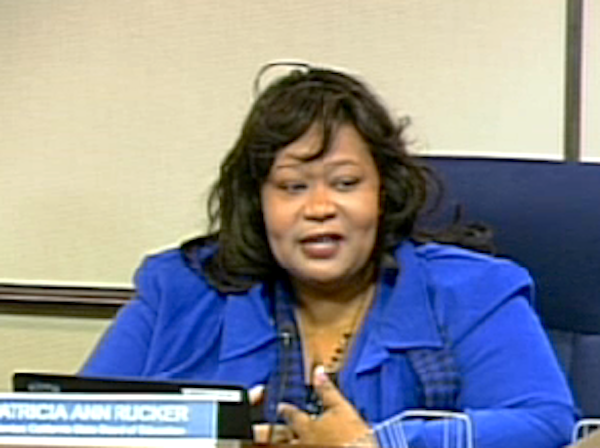
State Board of Didactics member Patricia Rucker.
 Source: California Department of Education webast
State Lath of Education member Patricia Rucker.
The Land Board of Pedagogy suspended the Bookish Performance Index for a 2d yr on Wednesday, moving one step closer to the 15-year-old accountability organisation's expected demise.
State board President Michael Kirst and other members accept made information technology articulate that they intend to replace the API, which calculates a three-digit number based primarily on a school'southward or district'due south standardized test scores, with a new organisation in which test scores would be just i of many measures of student achievement and school functioning. The extra twelvemonth will give the lath time to figure out what that organization should look like and to discuss statutory changes needed to make the transformation happen.
In adopting the Local Control Funding Formula, the Legislature established eight priorities that districts must address. The priorities, which will be core to a new accountability system, include schoolhouse climate, pupil engagement, access to courses leading to college and careers and the implementation of new academic standards, such every bit the Common Core Land Standards, as well as measures of pupil achievement.
By a unanimous vote, the board adopted the recommendations of an advisory committee, which had struggled with attempts to integrate non-test factors, like graduation rates, into the API. The Public Schools Accountability Advisory Human activity committee decided instead to urge the board to abandon a single index and launch a new accountability organization no before than fall 2016.
From a practical standpoint, the state board had little choice but to suspend the API, which the Legislature permitted it to do for two years. This bound, school districts are taking for the first time the Smarter Balanced tests of the Common Cadre standards in math and English language arts. It could be several years before Smarter Counterbalanced scores can exist used to estimate school and district performance. The state board hasn't set up a timeline, nor has it fix statewide target scores for the new tests.
Additionally, the Legislature ordered the country Department of Didactics to stop giving all other tests based on state standards, while the state creates a new generation of online tests that, like Smarter Counterbalanced, measure more complex learning skills. It will be at least three or 4 years before the state produces a new social studies test and a science test aligned with the Next Generation Science Standards, which the country adopted ii years ago.
Over the next year, the country board will decide whether the API should go on in a diminished form, with less clout, as one of many elements in a new accountability system, or disappear.
While the API presented a one-dimensional view of a school, it too had the virtue of simplicity. Information technology offered parents a blended number on which to measure a school's performance. By requiring the adding of carve up API numbers for educatee subgroups, it exposed gaps in achievement for low-income students, special education students and Hispanic and African-American children.
Several board members acknowledged that highlighting the achievement gap must non be lost in whatever arrangement replaces the API.
"Whether we think it was the best way to wait at a school, there has been progress identifying underperforming subgroups," said board member Trish Williams. "I heard from families that once they understood the API, they could await at their neighborhood school and decide whether it was where they wanted their child to nourish."
Lupe Aragon, a parent leader from 20th Street Simple School in Los Angeles Unified, reiterated that point, urging the board not to eliminate a system that is understandable.
Brian Rivas, director of policy and government relations for the advocacy group Education Trust-Westward, said the state board should be cautious about adding so many measures that a new system loses the focus on equity and "muddies the definition of what we consider a successful school."
Stephen Blake, a senior adviser for some other advancement group, Children Now, endorsed the concept of multiple measures but said "stakeholder groups had expressed feet" over an indefinite menses for suspending accountability measures.
Lath member Patricia Rucker acknowledged this business organisation, saying while information technology is of import to "hit the reset button" on a flawed API, the board should ready a clear borderline for moving ahead with its replacement.
To get more reports like this ane, click here to sign upwardly for EdSource's no-cost daily email on latest developments in education.
Source: https://edsource.org/2015/state-board-of-education-suspends-api-for-another-year/76316
0 Response to "State Board of Education suspends API for another year"
Post a Comment